
 Español
 Portugues
 Pусский
 Français
 Deutsch
 日本語
日本語 한국어
한국어 العربية
 Italiano
 Nederlands
 Ελληνικά
 Polski
 ไทย
ไทย Tiếng Việt
 українська
 中文简体
中文简体

Allyl Polyether
Allyl polyether is a versatile class of functional polymers derived from the combination of allyl groups and polyether segments. It is widely valued in industrial chemistry because it offers both chemical reactivity and flexible molecular design. The allyl group provides an active unsaturated site that can participate in a variety of chemical reactions, while the polyether chain contributes excellent flexibility, solubility, and compatibility with many organic and inorganic systems. As a result, allyl polyether materials are used in formulations that require both performance and adaptability.One of the most important characteristics of allyl polyether is its ability to serve as an intermediate in polymer synthesis. The allyl functionality can undergo addition, copolymerization, or modification reactions, making it useful in the preparation of specialty polymers, coatings, adhesives, sealants, and surfactants. Because the polyether backbone often contains repeating ethylene oxide or propylene oxide units, the material typically shows good hydrophilicity or amphiphilic behavior depending on its composition. This allows it to interact effectively with a broad range of substances.Allyl polyether is also appreciated for its tunable properties. By adjusting molecular weight, chain length, and the ratio of hydrophilic to hydrophobic segments, manufacturers can produce products with different viscosities, reactivities, and solubilities. This flexibility makes it suitable for use in water-based systems as well as in solvent-based formulations. In many applications, it helps improve dispersion stability, wetting performance, and compatibility between ingredients that might otherwise separate.In the field of polyurethane chemistry, allyl polyether can be used as a building block to introduce unsaturation or to create modified polyether polyols. Such materials can improve processing behavior and final product properties, including elasticity, durability, and resistance to environmental stress. In coatings and inks, allyl polyether may contribute to film formation, adhesion, and surface performance. In adhesives and sealants, it can enhance bonding strength while maintaining flexibility and resistance to cracking.Another advantage of allyl polyether is its potential for functional customization. It can be further reacted to introduce additional groups such as hydroxyl, carboxyl, or epoxy functionalities, broadening its application range. This makes it especially useful in advanced material development, where specific performance targets must be met. Its chemical structure also enables compatibility with reactive dilution systems and crosslinking processes, which is valuable in manufacturing durable and high-performance products.From a processing perspective, allyl polyether materials are often favored for their relatively manageable viscosity and good handling properties. These features help simplify formulation and mixing operations. In addition, many allyl polyether products can be designed to offer low volatility and stable storage behavior, which are important factors in industrial production.Overall, allyl polyether is an important functional material with broad industrial utility. Its combination of reactive allyl groups and adaptable polyether chains gives it a unique balance of chemical activity, flexibility, and compatibility. These qualities make it a valuable ingredient in modern polymer systems and a key component in the development of advanced materials across multiple industries.
Products
Category:
-
Polyether Amine CAT-5000
Category: Polyether Amine T seriesBrowse number: 40061Number: 64852-22-8Release time: 2019-04-28 22:30:46Polyether Amine CAT-5000 CHENHUA POLYETHER AMINE T Series products are triamines prepared by reaction of PO with a triol initiator, followed by amination of the terminal hydroxyl groups. Because of its characteristic structure as below,CH2O[CH2CH(CH3)O]X CH2CH(CH3)NH2CHO[CH2CH(CH3)O]YCH2CH(CH3)NH2CH2O[CH2CH(CH3)O]ZCH2CH(CH3)NH2x+y+... -
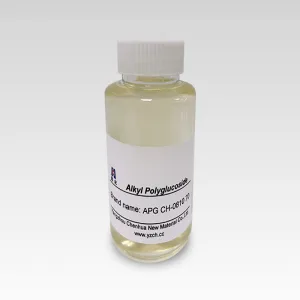
Alkyl Polyglucoside / APG CH-0810 70
Category: APGCH-0810Browse number: 10139Number:Release time: 2025-03-05 06:59:04ItemAPG CH-0810 50APG CH-0810 70APG CH-225NINCI NameCaprylyl/CaprylGlucosideCaprylyl/CaprylGlucosideCaprylyl/DecylGlucosideAppearance (25℃)Light yellow liquidLight yellow liquidBrown dark liquidSolid content (%)≥50.068.0-72.068.0-72.0pH value11.5-12.511.5-12.56.0-8.0Free alcohol (%)≤1.0≤1.0≤1.0Sulphated ash (%)≤3.0≤4.0≤4.0Viscosity mPa.s(20℃)≥100≥3500≥3500Applications and characteristics:ALKYL POLYGLUCOSIDE APG CH-0810 is made from green and renewable plant materials, with low irritation to skin, good compatibility, without side effect.The foam is rich and delicate, with good stability and emu...
News
Category:
-
[Industry News]Are Silicone Rubber Products Eco-Friendly?
2024-02-22 18:39:23
Case
Category:
No search results found!
Video
Category:
No search results found!
Download
Category:
No search results found!
Job
Category:
No search results found!
Featured Products
-
NEWS
Polyether Amine CAT-5000
Learn more -
NEWS
Alkyl Polyglucoside / APG CH-0810 70
Learn more



 Phone
Phone